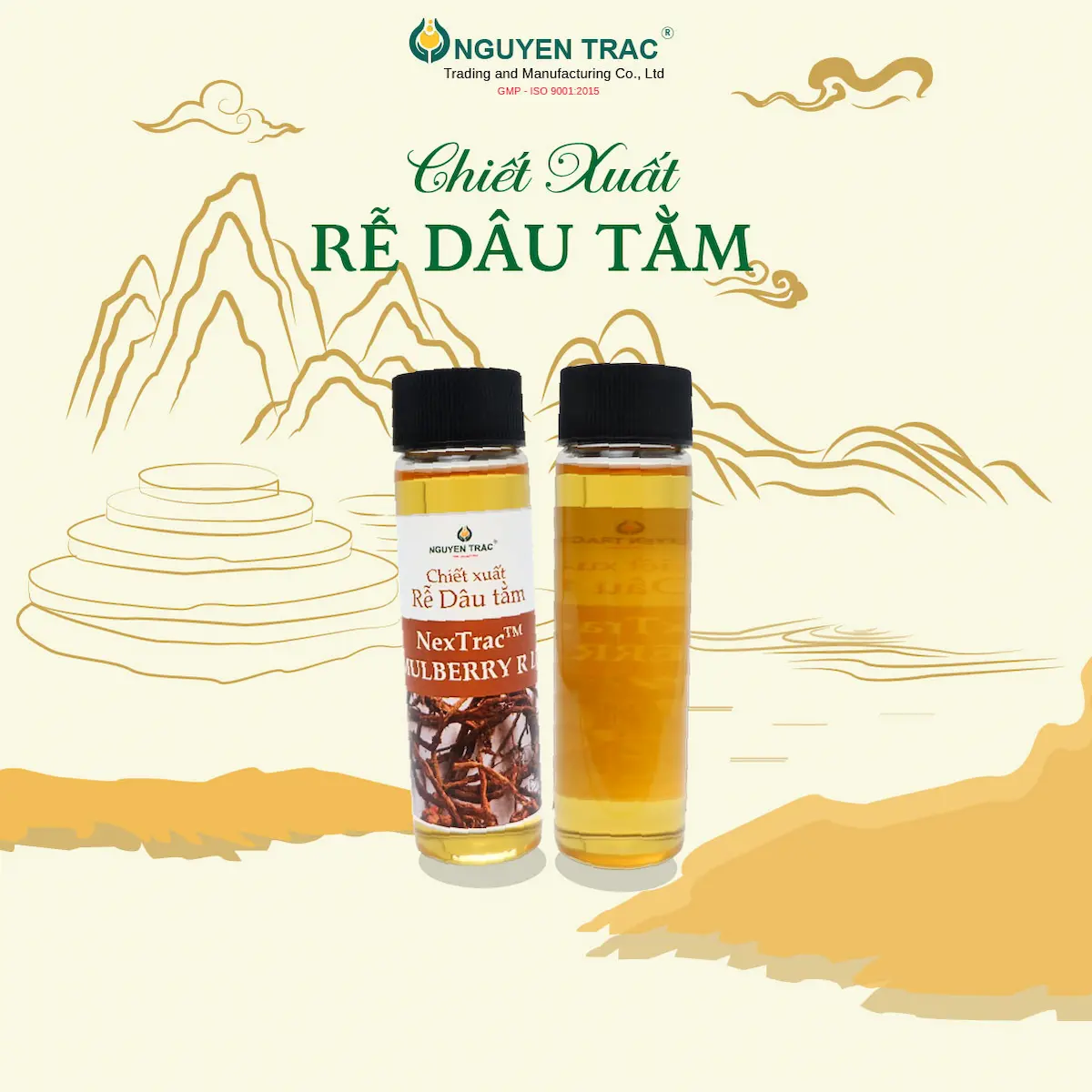
ALBA ROOT EXTRACT - NexTrac® MULBERRY R LC
INCI Name: Morus Alba Root Extract, Propylene Glycol, Ethoxydiglycol, Aqua, Phenoxyethanol, Ethylhexylglycerin.
Trade Name: NexTrac® MULBERRY R LC
Product Category: extract
CAS Number: N/A
MULBERRY ROOT BARK EXTRACT
Mulberry is a familiar plant in Vietnamese agricultural life, particularly associated with sericulture, the traditional practice of growing mulberry trees and raising silkworms. Beyond its leaves, which are used to feed silkworms, various parts of the mulberry tree have also been used in traditional medicine. Among them, mulberry root bark has a recognized place in traditional Vietnamese medicine.
Building on traditional use, modern research has increasingly focused on the chemical composition of mulberry root bark. Various compounds, including flavonoids, phenolics, and characteristic compounds of the Morus genus, have been identified, along with biological activities such as antioxidant activity, tyrosinase inhibition, and anti-inflammatory effects [1][2].
These findings open up opportunities to explore mulberry root bark extract not only for its traditional medicinal value but also as a plant-derived ingredient for skin care formulations.

KEY BENEFITS
Antioxidant Activity
- Kuwanon A helps enhance the activity of antioxidant enzymes, reduce ROS, and limit oxidative stress-induced damage to skin cells [4].
Tyrosinase Inhibition
- Mulberroside A and oxyresveratrol in mulberry root bark help inhibit tyrosinase and reduce MITF expression, thereby supporting the regulation of melanin production and helping maintain a brighter, more even-looking complexion [5].
Anti-inflammatory Activity
- Mulberry root bark extract and certain compounds, such as Albanol B and Morusin, have shown the ability to limit nitric oxide (NO) production, helping regulate inflammatory responses [2][3].
Antibacterial Activity
- Compounds such as oxyresveratrol, moracin, morusin, kuwanon G, and kuwanon L have shown the ability to inhibit the growth of certain Gram-positive and Gram-negative bacteria [6].
APPLICATIONS IN SKIN CARE PRODUCTS
Mulberry root bark extract can be explored for use in various skin care formulations, including serums, lotions, products for uneven skin tone, and soothing skin care products.
FREQUENTLY ASKED QUESTIONS
1. Can mulberry root bark extract help brighten the skin and improve skin tone?
Certain compounds in mulberry root bark, such as Mulberroside A and oxyresveratrol, have been studied for their ability to inhibit tyrosinase, an enzyme involved in melanin synthesis.
2. Is mulberry root bark extract the same as mulberry leaf extract?
No. The two ingredients are derived from different parts of the mulberry tree. Therefore, their chemical compositions and potential applications may differ.
3. Can mulberry root bark extract be applied directly to the skin?
Direct application should not be assumed to be appropriate. Mulberry root bark extract is a raw material used in cosmetic formulation development. Its recommended use concentration and safety should be assessed based on the ingredient's technical specifications, safety data, and the finished formulation.
REFERENCES
- Lee, K. T., Lee, K. S., & Kim, J. H. (2011). Antioxidant and antityrosinase activity of mulberry (Morus alba L.) twigs and root bark. Journal of Functional Foods, 3(2), 113–121.
- Chen, L., Li, X., Wang, Y., & Zhang, H. (2020). Antioxidant, anti-glucosidase, antityrosinase, and anti-inflammatory activities of bioactive components from Morus alba. Journal of Agricultural and Food Chemistry, 68(15), 4380–4390.
- Chung, K. O., Kim, K. E., & Park, H. J. (2013). Anti-inflammatory effects of mulberry (Morus alba L.) root bark and its active compounds. Journal of Ethnopharmacology, 148(1), 123–130.
- Kim, M. J., Park, S. Y., & Lee, S. Y. (2023). Kuwanon A from Morus alba L. alleviates H₂O₂-induced oxidative damage in HaCaT keratinocytes by inhibiting ferroptosis and enhancing antioxidant capacity. Molecules, 28(18), 6542.
- Gryn-Rynko, A. (2022). Screening and structure–activity relationship for selective and potent anti-melanogenesis agents derived from species of mulberry (Genus Morus). Molecules, 27(24), 9011.
- Yuan, Q., & Zhao, L. (2017). Nutritional constituents of mulberry and their potential applications in food and pharmaceuticals: A review. Trends in Food Science & Technology, 65, 85–95.
Product Information
- Origin: Vietnam
- Status: In stock
Related Products