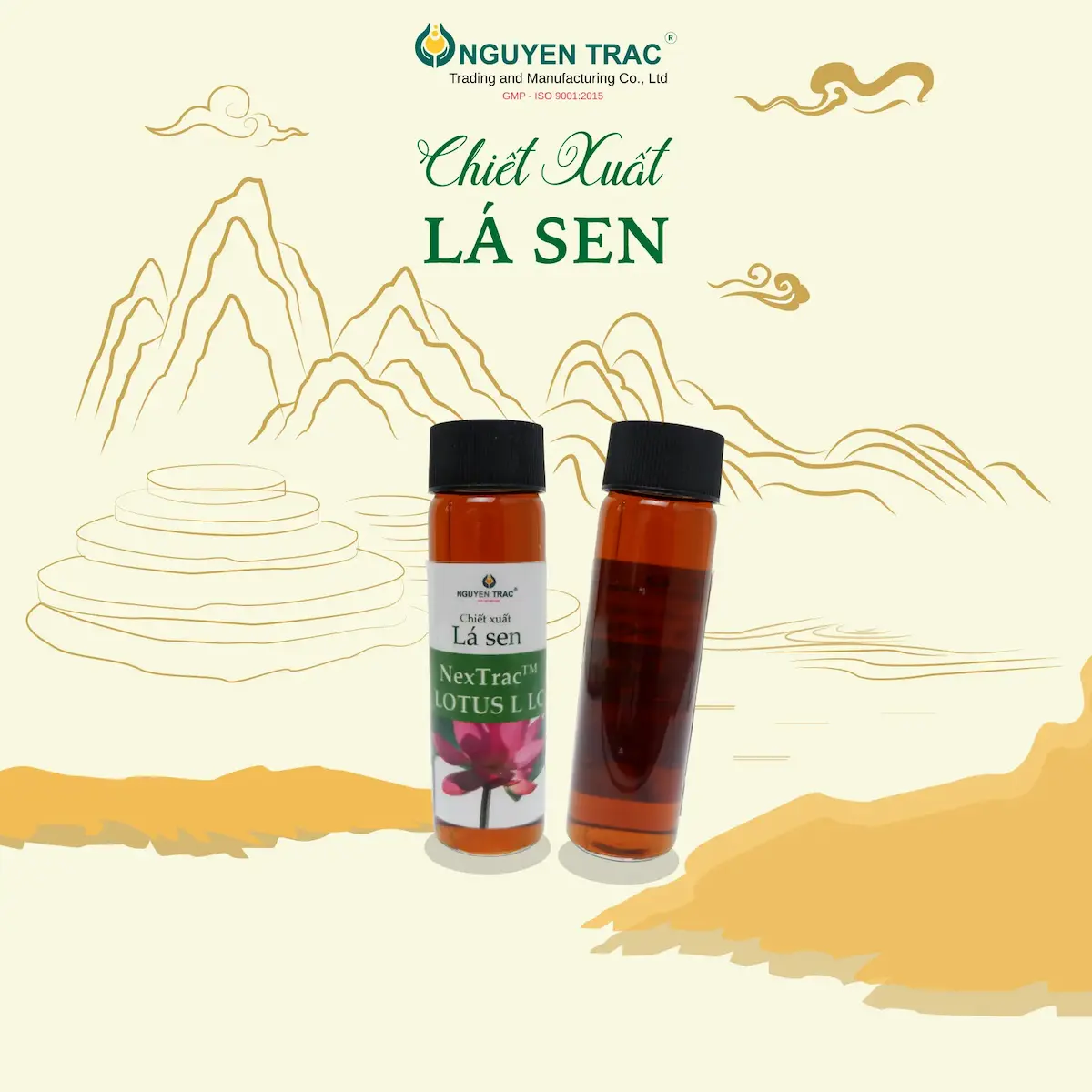
LOTUS LEAF EXTRACT - NexTrac™ LOTUS L LC
INCI Name: Nelumbo Nucifera Leaf Extract, Propylene Glycol, Aqua, Ethoxydiglycol, 1,2-Hexanediol
Trade Name: NexTrac™ LOTUS L LC
Product Category: extract
CAS Number: N/A, 57-55-6, 7732-18-5, 111-90-0, 6920-22-5
Lotus Leaf Extract – NexTrac™ LOTUS
INTRODUCTION
Lotus leaf extract (Nelumbo nucifera Leaf Extract) is obtained from the leaves of the lotus plant (Nelumbo nucifera Gaertn.), an aquatic species belonging to the Nelumbonaceae family. The plant is widely distributed throughout Asian countries, including Vietnam, China, India, Japan, and Thailand. Lotus leaves have long been used in traditional medicine and are now increasingly studied and applied in pharmaceuticals, nutraceuticals, and cosmetics due to their rich chemical composition and natural origin.
Lotus leaf extract is produced from mature lotus leaves through appropriate extraction and purification processes designed to remove impurities while recovering and concentrating the naturally occurring compounds present in the plant material. Its chemical composition is highly diverse and includes various groups of bioactive compounds, such as phenolic acids, flavonoids, alkaloids, polysaccharides, terpenoids, and other phytochemicals [3]. This chemical diversity has made lotus leaf extract an ingredient of considerable interest in studies related to medicinal plants and cosmetic raw materials.
Lotus leaf extract is currently incorporated into a wide range of botanical-based cosmetic formulations, including creams, serums, toners, facial masks, and other skincare products. Owing to its natural origin, rich phytochemical profile, and compatibility with various cosmetic actives, lotus leaf extract is becoming an increasingly popular botanical ingredient in modern skincare products.

KEY BENEFITS
Antioxidant Activity and Protection Against UV-Induced Damage
One of the most notable properties of lotus leaf extract is its antioxidant activity. The extract can neutralize reactive oxygen species (ROS), reduce lipid oxidation, and help limit cellular damage caused by oxidative stress. Through these mechanisms, it helps protect skin cell structures against the effects of ultraviolet radiation and environmental stressors while supporting the prevention of premature skin aging [1][3].
Anti-Inflammatory and Skin-Soothing Activity
The flavonoids present in lotus leaf extract can modulate inflammatory responses by inhibiting nitric oxide (NO) production, reducing the expression of inflammatory mediators such as iNOS and COX-2, and decreasing levels of pro-inflammatory cytokines, including IL-1β and IL-6. They may also promote the expression of the anti-inflammatory cytokine IL-10. These mechanisms help alleviate irritation and redness while supporting the restoration of skin balance [2][3].
Helps Reduce Hyperpigmentation and Improve Skin Tone
Several studies have reported that lotus leaf extract may inhibit melanogenesis by reducing the activity of tyrosinase, a key enzyme involved in melanin synthesis. Therefore, the ingredient has the potential to improve dull-looking skin, promote a more even skin tone, and help reduce the appearance of hyperpigmented spots when incorporated into skincare formulations [4].
COSMETIC APPLICATIONS
In cosmetic formulations, lotus leaf extract can be incorporated into:
- Lotions
- Moisturizing creams
- Serums
- Facial masks
REFERENCES
[1] Lin, H. Y., Kuo, Y. H., Lin, Y. L., & Chiang, W. (2009). Antioxidative effect and active components from leaves of lotus (Nelumbo nucifera). Journal of Agricultural and Food Chemistry, 57(15), 6623–6629.
[2] Park, E., Kim, G. D., Go, M. S., Kwon, D., Jung, I. K., Auh, J. H., & Kim, J. H. (2017). Anti-inflammatory effects of Nelumbo leaf extracts and identification of their metabolites. Nutrition Research and Practice, 11(4), 265–274.
[3] Li, C., He, Y., Yang, Y., Gou, Y., Li, S., Wang, R., Zeng, S., & Zhao, X. (2021). Antioxidant and inflammatory effects of Nelumbo nucifera Gaertn. leaves. Oxidative Medicine and Cellular Longevity, 2021, 8375961.
[4] Sable, N. V., & Pagar, S. A. (2013). A review on lotus: Use in herbal cosmetics. Research Journal of Topical and Cosmetic Sciences, 4(1), 81–83.
Product Information
- Origin: Vietnam
- Status: In stock
Related Products